Reusing Plastic Water Bottles: What Studies Show in 2026
This article has been updated 3 times. Last updated on
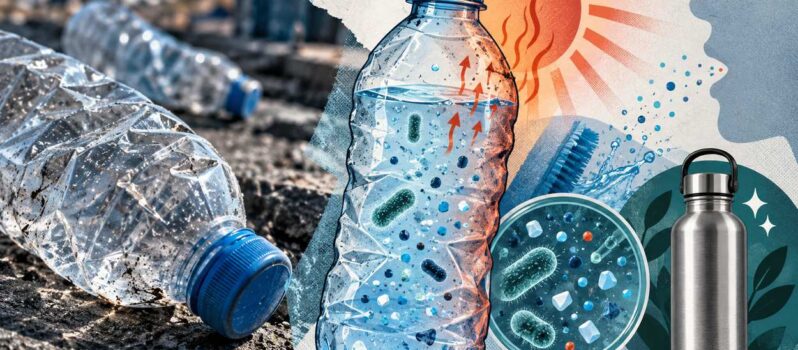
Used PET water bottles carried a microbial load of 68.8 cfu/ml at initial sampling, significantly higher than the 35.4 cfu/ml found in SS (stainless steel) bottles, across 30 water bottles gathered from different users, according to a 30-bottle study indexed by the National Library of Medicine. That gap is the everyday case against reusing plastic water bottles, and heat adds a chemical one: by increasing the duration of storage time and temperatures, antimony leaching from the PET bottles into the bottled water increased, according to a PET storage study indexed by the National Library of Medicine.
Neither finding means one refill will make you sick. Both mean a single-use bottle gets riskier the longer you keep it, the less you wash it, and the warmer it gets. The sections below cover what single-use bottles are made of, how bacteria build up once you drink from one, what heat does to the plastic, where BPA and microplastics fit, whether the dishwasher helps, and how to clean or replace the bottle you already own.
In a study of bottles in daily use, PET harbored a 70% increase in microbial load after 3 h of use, against 23% for SS bottles, and 27 (90%) people regularly refilled their bottles without washing or rinsing. That is why the standard advice says not to reuse them casually.
The bottled water industry does reuse some containers, just not the small ones. Returnable polycarbonate 3- and 5-gallon HOD water cooler bottles are cleaned and sanitized between uses and are reused 30 to 50 times before being recycled, according to IBWA, the International Bottled Water Association. A single-serve bottle refilled at the kitchen tap gets none of that commercial sanitizing, which is the real difference between it and the jug on a home water cooler dispenser.
| Bottle plastic | Share of plastic water bottles | Typical bottled water use | What the research flags |
|---|---|---|---|
| PET (#1) | 78.8% | 24-ounce, 16.9-ounce, and 8-ounce single-serve bottles | Antimony leaching rises with storage time and temperature |
| Polycarbonate (PC) | 12% | Returnable 3- and 5-gallon cooler bottles | Made using BPA, which FDA calls safe at current levels |
| HDPE (#2) | 9.2% | 1-gallon jugs and 2-gallon water dispensers | FDA-approved for food contact, per IBWA |
Source: International Bottled Water Association packaging data; FDA, 2024; antimony storage study, PMC 2014
The bottle’s material explains most of that difference.
PET accounts for 78.8% of plastic water bottles, PC for 12% and HDPE for 9.2%, according to IBWA figures, and plastic containers comprise 97.3% of the bottled water market, while glass bottles account for 2.3%. PET is easily identified by the #1 recycling code on or near the bottom of the container, so check the base of the bottle you are refilling.
Single-serve PET is also very light. Between 2000 and 2014, the average weight of a 16.9-ounce, single-serve PET bottled water container declined 51% to just 9.25 grams, and some weigh as little as 7.5 grams. By comparison, soda and other drink containers must be thicker due to carbonation and manufacturing processes and weigh, on average, 23.9 grams.
A lighter bottle uses less plastic, which is good for waste. It also means very little material stands between the water and whatever the bottle goes through once it leaves the store: squeezing, a hot car, a scrub brush. HDPE is another plastic bottled water packaging material that the FDA has approved as safe for food contact, typically used in 1-gallon jugs and 2-gallon water dispensers available at grocery stores.
At initial sampling, used PET bottles carried 68.8 cfu/ml against 35.4 cfu/ml for stainless steel bottles. In the same 30-bottle study, water bottles with direct mouth contact had a microbial load of 234 cfu/ml versus 132 cfu/ml for non-mouth contact, and 22 (73%) people drank water by direct mouth contact. Among them, 50% shared their water bottles with others.
Germs also settle into the bottle itself. According to the University of New Hampshire Extension, bacteria can continue to grow and form what is known as a biofilm in the bottle, and biofilms can stick to the inside of the bottle, shielding those bacteria from cleaning supplies.
Older school data points the same way. In drinking water sampled from the personal water bottles of students at an elementary school in Calgary, Alberta, the total coliform criterion was exceeded in 13.3% of 75 samples, in a study published in the Canadian Journal of Public Health in 2002. Fecal coliform and total heterotrophic criteria were exceeded in 8.9% (of 68 samples) and 64.4% (of 76 samples).
Key finding: The Calgary researchers tested water straight from students’ own bottles and found the total heterotrophic criterion exceeded in 64.4% of 76 samples. They concluded that the use of personal water bottles for students in elementary classrooms is not recommended. The same logic applies to an adult refilling a single-use bottle all week.
Mostly, bacteria from your mouth and hands colonize the inside, and they multiply between refills when the bottle is not washed. In the 30-bottle study, PET harbored a 70% increase in microbial load after 3 h of use. Washing is what reverses it: the cleaning strategy significantly reduced the microbial load to a mean of 11.2 cfu/ml post-wash.
Antimony (Sb) is a contaminant that may leach from the polyethylene terephthalate (PET) bottles into the water, and in one PET storage study the average Sb concentrations were approximately 1.01 ppb at the initial stage and rose to 2.54 ppb after 8 weeks at room temperature.
Those levels stayed under the drinking water limit. At 40°C, outdoors, and at room temperature, the Sb concentrations were below the MCLs, i. e., 6 ppb. The limit matters because short-term exposures to levels higher than MCL can cause side effects such as nausea, vomiting, and diarrhea.
Single-use plastic water bottles contain chemicals that can leach into the water we drink, the University of New Hampshire Extension notes. At room temperature and over weeks, antimony stays well inside the limit, so the practical question is what pushes it higher. The answer is heat.
In the same storage study, at 65°C and 80°C for longer storage times, Sb concentration exceeded the MCLs, and the paper cites earlier work in which Westerhoff et al. showed that high storage temperatures and sunlight exposure increased the leakage of antimony into the bottled waters.
Westerhoff’s figures give the timeline. The amounts of Sb exceeded the MCL in the following conditions: 60°C in 176 days, 65°C in 38 days, 70°C in 12 days, 75°C in 4.7 days, 80°C in 2.3 days, and 85°C in 1.3 days. For a US reader, 60°C works out to 140°F.
Hot car storage: A separate migration study states that storing PET bottled drinks at elevated temperatures (i.e., in a hot car or in summer) can cause antimony migration to exceed the limits allowed in the EU or USA. Do not refill and drink from a bottle that has been sitting in a hot car.
The same research found that both matrix characteristics and type of PET bottle greatly influence antimony leaching, so results vary by drink and by bottle. The practical rule is simple: keep a refilled bottle out of the car and out of direct sun.
Per FDA’s BPA food-contact guidance, BPA is an industrial chemical used to make polycarbonate, a hard, clear plastic, which is used in many consumer products, and BPA is a structural component in polycarbonate beverage bottles. Polycarbonate plastic and epoxy resins are made using bisphenol A (BPA), IBWA confirms.
FDA’s position on current exposure is that BPA is safe at the current levels occurring in foods, and the available information continues to support the safety of BPA for the currently approved uses in food containers and packaging. FDA granted two petitions to no longer provide for the use of certain BPA-based materials in baby bottles, sippy cups, and infant formula packaging because these uses have been abandoned.
For a refilled single-serve bottle, check the recycling code first. A #1 bottle is PET, and the leaching studies on PET track antimony and heat, while the FDA’s BPA findings concern polycarbonate.
On average, a liter of bottled water contained some 240,000 detectable plastic fragments, 10 to 100 times greater than previous estimates, in research led by Columbia University scientists. The researchers tested three popular brands of bottled water sold in the United States and spotted 110,000 to 370,000 particles in each liter, 90% of which were nanoplastics.
According to the Columbia account, PET probably gets into the water as bits slough off when the bottle is squeezed or gets exposed to heat, and one recent study suggests that many particles enter the water when you repeatedly open or close the cap, and tiny bits abrade. Squeezing, warming, and opening the cap are all things a refilled bottle goes through again and again.
By the numbers: Bottled water drew attention after a 2018 study detected an average of 325 particles per liter. The Columbia team’s newer method counted some 240,000 detectable plastic fragments per liter on average, 10 to 100 times greater than previous estimates, because it reached down to nanoplastics.
What those particles do in the body is still unknown. WHO’s assessment is cautious:
“Based on the limited information we have, microplastics in drinking water don’t appear to pose a health risk at current levels. But we need to find out more,” said Dr Maria Neira, Director, Department of Public Health, Environment and Social Determinants of Health, WHO.
WHO also noted that absorption and distribution of very small microplastic particles, including in the nano-size range, may, however, be higher, although the data is extremely limited. Refilling a bottle from a filtered tap sidesteps the bottled-water count altogether, which is one reason to look at how a reverse osmosis system works if you drink a lot of water at home.
Two chemists from the University of Copenhagen studied which chemical substances are released into liquids by popular types of soft plastic reusable bottles, and the most toxic substances they identified came after the bottle had been in the dishwasher, presumably because washing wears down the plastic and thereby increases leaching.
In new reusable bottles, close to 500 different substances remained in the water after an additional rinse, and over 100 of these substances came from the plastic itself. Even of the identified chemicals, the toxicity of at least 70% remains unknown. The researchers were careful about health effects: they have yet to conclude whether the water in the bottles is harmful to health, as toxicological assessments have yet to be completed.
Worth noting: The Copenhagen team studied soft plastic reusable bottles, not single-use PET, and left ordinary tap water in both new and used drinking bottles for 24 hours, both before and after machine washing. The result still applies to any plastic you plan to put through a dishwasher repeatedly: washing removes germs but wears the surface.
Wear matters for germs too. University of New Hampshire Extension says plastic is the softest material, making it most susceptible to scratching, and these scratches provide small cracks in the water bottle’s material that can harbor bacteria.
IBWA’s reuse figure applies to a different container: returnable polycarbonate 3- and 5-gallon HOD bottles are cleaned and sanitized between uses and are reused 30 to 50 times before being recycled, per IBWA. None of the studies above set a safe number of refills for a single-serve bottle, so treat one as a short-term container. For water you store at home, CDC’s emergency water guidance says it is best to use FDA-approved food-grade water storage containers, because FDA-approved food-grade storage containers will not transfer toxic substances into the water.
Do not use containers that were previously used to hold liquid or solid toxic chemicals, such as bleach or pesticides, CDC adds. Retire a single-serve bottle as soon as it is scratched, dented, cloudy, or has been left in a hot car.
Only as long as you can keep it clean and cool. For stored drinking water, the CDC advises replacing water every six months, keeping containers in a place with a cool temperature (50°F to 70°F), and keeping containers away from direct sunlight. For a bottle you drink from, ideally the water bottle should be cleaned daily, according to the University of New Hampshire Extension.
The steps below come from CDC’s emergency water guidance:
Scrub gently. A soft brush reaches the bottom without gouging the plastic, and a bottle you cannot reach inside is a bottle you cannot clean. Using abrasive detergents to scrub away biofilm can create scratches inside the bottle, UNH Extension warns.
In the 30-bottle comparison, SS bottles carried 35.4 cfu/ml at initial sampling against 68.8 cfu/ml for PET, and after 3 hours of use the increase was 23% for SS bottles against 70% for PET.
Glass is the other common choice. Glass is least likely to scratch and makes it easier to spot buildup since it’s transparent; however, it may be more prone to shattering. One of the Copenhagen chemists drew his own conclusion: “Although we cannot yet say whether the substances in the reusable bottles affect our health, I’ll be using a glass or quality stainless steel bottle in the future,” said Professor Christensen.
If you want filtered water on the go, filtered water bottles pair a reusable body with a replaceable filter. At home, check whether a filter pitcher is necessary for your tap water before you buy one.
Used PET bottles carried 68.8 cfu/ml of microbes against 35.4 cfu/ml for SS bottles, and antimony leaching from the PET bottles increased with storage time and temperatures. Reusing a plastic water bottle for a day or two, washed and kept cool, carries far less risk than the alternative. Refilling the same bottle for weeks, drinking from it directly, and leaving it in a hot car stacks the risks the studies measured.
Anyone who drinks water all day, and especially parents packing bottles for school, gets the most from switching to a stainless steel or glass bottle and washing it daily. Pair it with filtered tap water, and the single-use bottle stops being part of the routine.

Leave a Reply