Benefits of Reverse Osmosis Systems: What the Evidence Shows
This article has been updated 3 times. Last updated on
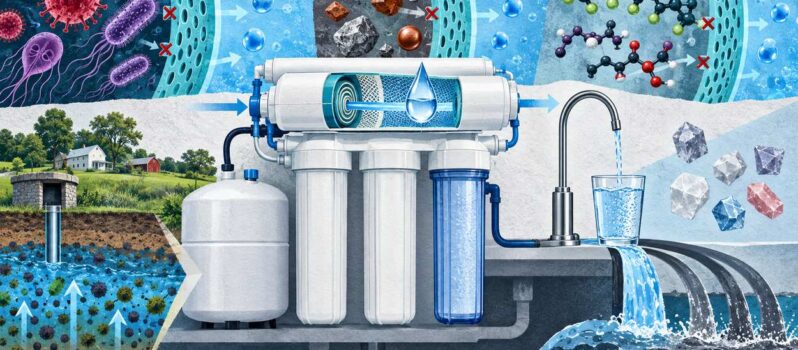
A reverse osmosis filter has a pore size of about 0.0001 microns, according to the Centers for Disease Control and Prevention (CDC), and the agency lists it as removing parasites, bacteria, and viruses, plus chemicals including lead, copper, chromium, chloride, and sodium (salt). The benefits of reverse osmosis systems extend to PFAS: in a Duke University and North Carolina State University field study, under-sink units reduced PFAS levels, including GenX, by 94% or more.
Those gains carry costs that dealer pages rarely put a number on. According to EPA’s WaterSense program, a typical point-of-use RO system will generate five gallons or more of reject water for every gallon of treated water produced, and CDC notes RO may also reduce levels of calcium, magnesium, and potassium along with the contaminants. Each benefit below is matched to the agency or study behind it, then weighed against those costs, so you can judge whether your water needs one.
Reverse osmosis filters water through a pore size of about 0.0001 micron, according to the CDC, which lists it as removing parasites, bacteria, and viruses, lead, copper, chromium, chloride, and sodium (salt). That range- germs plus metals- is the core benefit.
Pitcher and refrigerator carbon filters serve a narrower job: CDC says their main purpose is to improve the taste and smell, rather than the safety, of water.
| Benefit | What the evidence shows | Source |
|---|---|---|
| Germ removal | Parasites, bacteria, and viruses; pore size about 0.0001 micron | CDC |
| Metals and salt | Lead, copper, chromium, chloride and sodium | CDC |
| PFAS reduction | 94% or more in field testing | Duke University, NC State |
| Nitrate in wells | Free under-sink RO for eligible wells over 10 mg/L | Minnesota Department of Health |
| Certified TDS reduction | Required claim under NSF/ANSI 58 | NSF |
Source: CDC, Duke University, Minnesota Department of Health, NSF
The mechanism itself, from membrane to pressure to prefilters, is covered in our explainer on how a reverse osmosis system purifies water. The sections below stay on outcomes: what leaves the water, how well, and at what cost.
A reverse osmosis filter’s pore size of about 0.0001 micron is 10 times finer than the about 0.001 micron CDC gives for nanofiltration, the next step up the ladder. CDC puts microfiltration at about 0.1 micron and ultrafiltration at about 0.01 micron, and the germs and chemicals each one catches shrink as the pores do.
| Filter type | Pore size (micron) | Germs removed | Chemicals |
|---|---|---|---|
| Ultrafiltration | about 0.01 | Parasites, bacteria; somewhat effective on viruses | Does not remove chemicals |
| Nanofiltration | about 0.001 | Parasites, bacteria, viruses | Somewhat effective |
| Reverse osmosis | about 0.0001 | Parasites, bacteria, viruses | Removes some, including lead and sodium |
Source: CDC 2024
The gap matters most against carbon. CDC’s broader rule is that reverse osmosis filters remove germs and some types of chemicals, which is why it outperforms carbon on safety rather than taste. If your only complaint is chlorine taste, a certified pitcher may do; our look at whether water filter pitchers are necessary covers where that line falls.
No single system wins on every contaminant. The Minnesota Department of Agriculture states that no single treatment process can remove all substances in water. Distillation is the closest rival: CDC says it leaves behind many of the germs and chemicals that were in the water, but it generally uses more energy and takes longer than other water treatment systems.
At a pore size of about 0.0001 micron, reverse osmosis removes parasites, bacteria, and viruses, according to the CDC. That covers all three germ groups the agency tracks, while ultrafiltration is only somewhat effective at removing viruses, meaning the filter may remove some viruses and let others through. That makes RO a fit for households on untreated or suspect sources.
CDC’s label guide ties certification to the claim. Among the NSF standards it lists are Standard 53 (cyst reduction) and Standard 58 (reverse osmosis), so an RO unit’s box should name Standard 58 before you rely on it.
Germ removal holds only while the membrane and prefilters are in good shape. The Minnesota Department of Health warns that water treatment units that are not properly maintained will lose their effectiveness over time.
CDC names the chemicals reverse osmosis will remove: lead, copper, chromium, chloride, and sodium, and a longer list it may reduce: arsenic, fluoride, radium, sulfate, calcium, magnesium, potassium, nitrate, and phosphorus. The gap between “will” and “may” is why the product label, not the technology, decides what you get.
NSF/ANSI 58, the standard for home RO units, makes one claim mandatory: TDS (total dissolved solids) reduction. Everything else is optional, including arsenic reduction, nitrate/nitrite reduction, cadmium reduction, and lead reduction.
Read the NSF/ANSI 58 claim list: A system certified to NSF/ANSI 58 has passed TDS (total dissolved solids) reduction testing, but lead, arsenic or nitrate reduction are separate optional claims. Match the listed claims to your water test before you buy.
The standard also covers an efficiency rating and recovery rating, the two numbers that tell you how much water a unit wastes. That rating becomes the second half of the buying decision, covered in the water-waste section below.
Reverse osmosis and two-stage filters led the household PFAS field data. Duke University and North Carolina State University researchers found that reverse osmosis filters reduced PFAS levels, including GenX, by 94% or more in water, while activated-carbon filters removed 73% of PFAS contaminants, on average, but results varied greatly.
“All of the under-sink reverse osmosis and two-stage filters achieved near-complete removal of the PFAS chemicals we were testing for,” said Heather Stapleton, the Dan and Bunny Gabel Associate Professor of Environmental Health at Duke’s Nicholas School of the Environment.
Regulators back the method. EPA lists reverse osmosis among filter types that can be effective at reducing PFAS, and the Minnesota Department of Health warns that other types of common water treatment systems, such as water softeners or iron filtration systems, are not likely to remove PFAS. Boiling water will not remove PFAS either. EPA’s enforceable limit for PFOA and PFOS is 4.0 parts per trillion (ppt).
Key finding: The Duke and NC State team tested 76 point-of-use filters and 13 point-of-entry or whole-house systems and found their effectiveness varied widely. Carbon results swung widely: in some cases, the chemicals were completely removed; in other cases they were not reduced at all. Reverse osmosis was the consistent performer.
Minnesota treats reverse osmosis as the practical fix for high-nitrate private wells. The state’s health department tells well owners that if nitrate runs over 10 mg/L, you may be eligible for a free under-the-sink reverse osmosis system, and the Minnesota Department of Agriculture has a formal work plan and agreement in place with local partners for this program.
The program targets private well users in the eight-county area with nitrate levels in their water above 10 mg/L. The agency identified some eligible households through their private well testing programs and sent out invitation letters in May 2024.
Nitrate and infants: If well nitrate tests above 10 mg/L, the Minnesota Department of Health says to make sure babies under six months old do not drink the well water. Do not try to boil nitrate out of the water. Boiling will make nitrate more concentrated.
For a well owner, that sequence is the whole argument: test, switch to a safe source, then treat. An RO unit with a certified nitrate claim covers the treat step at one tap.
Water waste is the main cost of reverse osmosis. EPA’s WaterSense program says a typical point-of-use RO system will generate five gallons or more of reject water for every gallon of treated water produced, and some inefficient units will generate up to 10 gallons of reject water for every gallon of treated water produced.
| RO system type | Reject water per treated gallon (gallons) | Source |
|---|---|---|
| Inefficient unit | Up to 10 | EPA WaterSense |
| Typical point-of-use unit | Five or more | EPA WaterSense |
| WaterSense-labeled unit | 2.3 or less | EPA WaterSense |
Source: US EPA WaterSense 2024
Labeled units must prove it: EPA says they send just 2.3 gallons of water or less down the drain for every gallon of treated water they produce, and all products bearing the WaterSense label are independently certified to ensure they meet EPA criteria for efficiency and performance.
By the numbers: Picking a labeled model will reduce water use on average by more than 3,100 gallons of water per year, or 47,000 gallons over the lifetime of the system, per EPA. If all point-of-use RO systems sold in the United States were WaterSense labeled, we could save more than 3.1 billion gallons of water across the country annually, the agency estimates.
If you already track household water use, our list of ways to conserve water at home shows where an RO drain line fits among the bigger savings.
The biggest downside is reject water: Five gallons or more of reject water for every gallon of treated water produced on a typical unit, per the EPA. RO may also reduce levels of arsenic, fluoride, radium, sulfate, calcium, magnesium, and potassium, so beneficial minerals leave with harmful ones, and every unit needs filter changes to keep working.
Reverse osmosis removes minerals without sorting useful ones from harmful ones. CDC says RO systems may also reduce levels of arsenic, fluoride, radium, sulfate, calcium, magnesium, potassium, nitrate, and phosphorus, so calcium, magnesium, and fluoride can drop along with arsenic and nitrate. How much that matters depends on how mineral-rich your tap water was to begin with.
Worth noting: Water is a variable mineral source to begin with. The National Institutes of Health says tap, mineral, and bottled waters can also be sources of magnesium, but the amount of magnesium in water varies by source and brand (ranging from 1 mg/L to >120 mg/L). A soft-water household loses little to RO; a hard-water household loses more.
The answer turns on what your tap water contains. CDC advises that if your tap water does not contain harmful chemicals or germs, you may not need a home water treatment system. The trade-off is minerals, since RO may also reduce levels of calcium, magnesium, and potassium. Questions about your own diet or health belong with a doctor.
A reverse osmosis system earns its cost when a water test finds something it removes. CDC says if your tap water does not contain harmful chemicals or germs, you may not need a home water treatment system.
Testing can even cost more than the fix. The Minnesota Department of Agriculture notes that the cost to test for pesticides in water may exceed the cost of a point-of-use home treatment system, such as reverse osmosis for drinking water.
Start with a lab-grade or home water test, then match the result to a unit. The Minnesota Department of Agriculture advises that the unit you choose should be certified and labeled to reduce or remove the substance you are concerned about.
Placement matters too. Point-of-use systems treat water in batches and deliver it to a single tap, such as your kitchen sink, and the Minnesota Department of Health says reverse osmosis is more practical as a point-of-use treatment option (not at point-of-entry). It adds that point-of-use treatment tends to be more economical than point-of-entry. Our comparison of under-sink reverse osmosis systems lists the NSF/ANSI 58 claims for each model.
RO water is safer than tap water only when the tap water carries something RO removes. CDC says reverse osmosis filters remove germs and some types of chemicals; if a test shows none of those at harmful levels, you may not need a home water treatment system at all.
Both remove germs and many chemicals, so the choice comes down to speed and energy. CDC says distillation systems boil water and then collect the water as it cools, which generally uses more energy and takes longer than other water treatment systems.
Reverse osmosis instead pushes water through a membrane with a pore size of about 0.0001 micron.
For a family drinking a few gallons a day, RO at the kitchen sink is the more practical fit; distillation suits smaller batches. Our guide to distilled versus purified water covers the drinking-water side in more depth.
A reverse osmosis system’s main benefit is reach: pores of about 0.0001 micron that CDC credits with removing parasites, bacteria, and viruses, plus lead and sodium, and under-sink units that reduced PFAS levels, including GenX, by 94% or more in Duke and NC State testing. Minnesota’s free program for high-nitrate wells shows public health agencies treat it as a working fix for a regulated contaminant.
The costs are just as concrete. A typical unit wastes five gallons or more of reject water for every gallon of treated water produced; minerals leave with contaminants, and none of it helps if your water tests clean. Test first, buy a unit certified for what the test found, and choose a WaterSense-labeled model, which must send just 2.3 gallons of water or less down the drain for every gallon of treated water they produce.

Leave a Reply